Massachusetts prohibits court-appointed parenting-time supervisors from delegating their appointments. The judiciary's own records offer a way to examine who supervised children, under whose authority, and at what cost.
Family Court Watch Collective | Investigations
1. The Hiring Advertisement Raises a Serious Question.
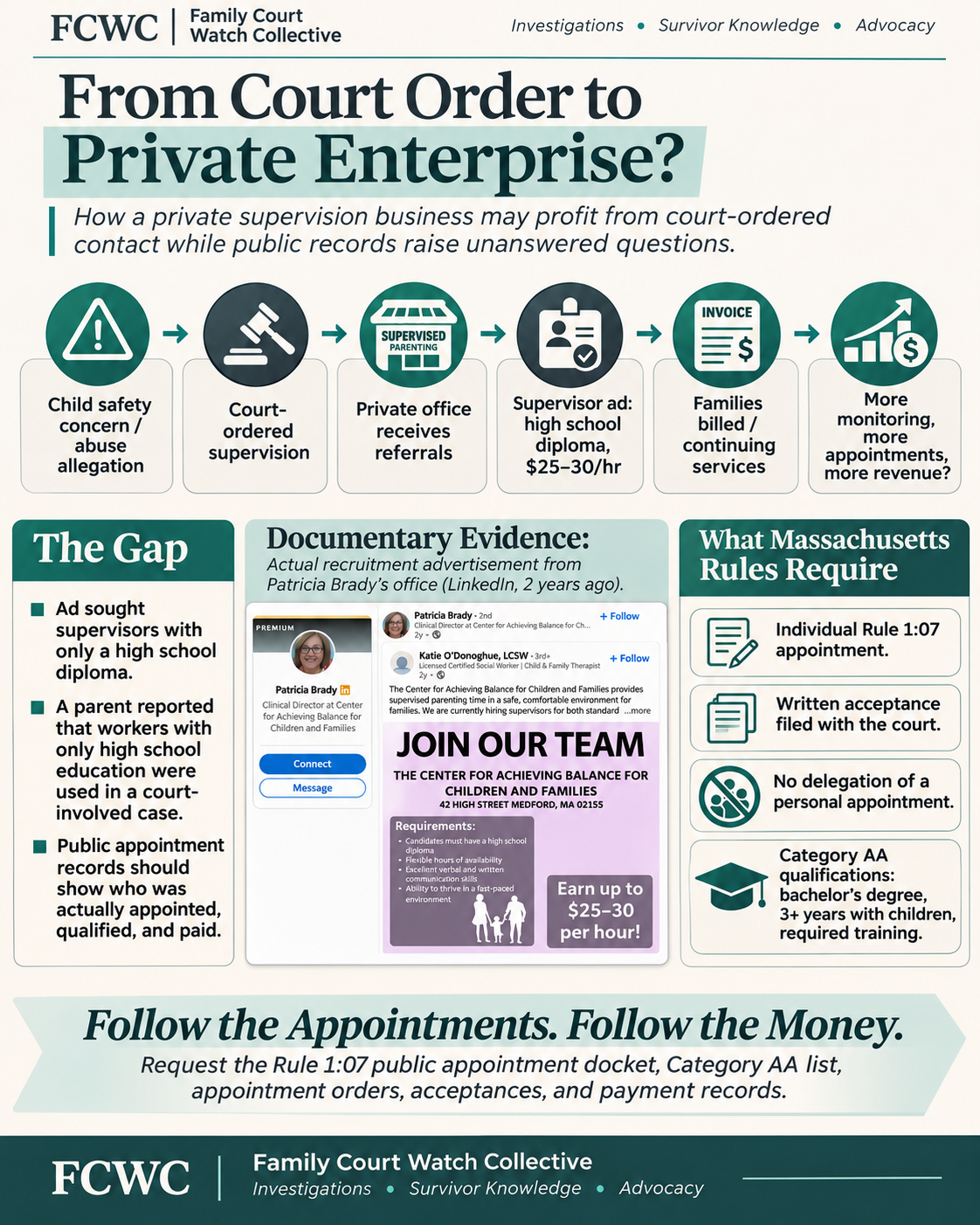
Patricia Brady's Center for Achieving Balance for Children and Families advertised parenting-time supervision jobs requiring only a high school diploma, offering up to $25–$30 per hour.
A parent with firsthand experience of Brady's office reports that workers whose highest completed education was high school conducted parenting-time supervision in her court-involved case.
Massachusetts' Category AA qualifications tell a different story. Court-approved professional supervisors must have a bachelor's degree, at least three years of professional experience working with children, and specialized training. Even appointments outside the approved list require the court to document how the individual qualifies. Massachusetts Guidelines, § II(A)–(C).
How does a court-ordered child-protection service become a private staffing operation, and who verifies the people actually supervising children?
The recruitment advertisement and firsthand account establish a concrete reason to examine the practice's supervision assignments. Appointment orders, written acceptances, and supervision logs provide the evidence needed to determine who was authorized to do the work.
2. Court Appointments Cannot Be Delegated.
Massachusetts' 2023 Guidelines require an individual appointment under Supreme Judicial Court Rule 1:07 and written acceptance before a professional supervisor's appointment becomes effective. Guidelines, § II(A).
Standing Order 1-23, § H(1)(c), expressly prohibits delegating any portion of that appointment because it is personal in nature. The same provision prohibits supervisors from providing therapy or counseling in their supervisory role. Standing Order 1-23, § H.
A judicial appointment belongs to the named professional, not to an office with interchangeable employees.
The standing order governs court-ordered professional supervision and agreements incorporated into court orders, not entirely private arrangements outside those orders. Standing Order 1-23, § A.
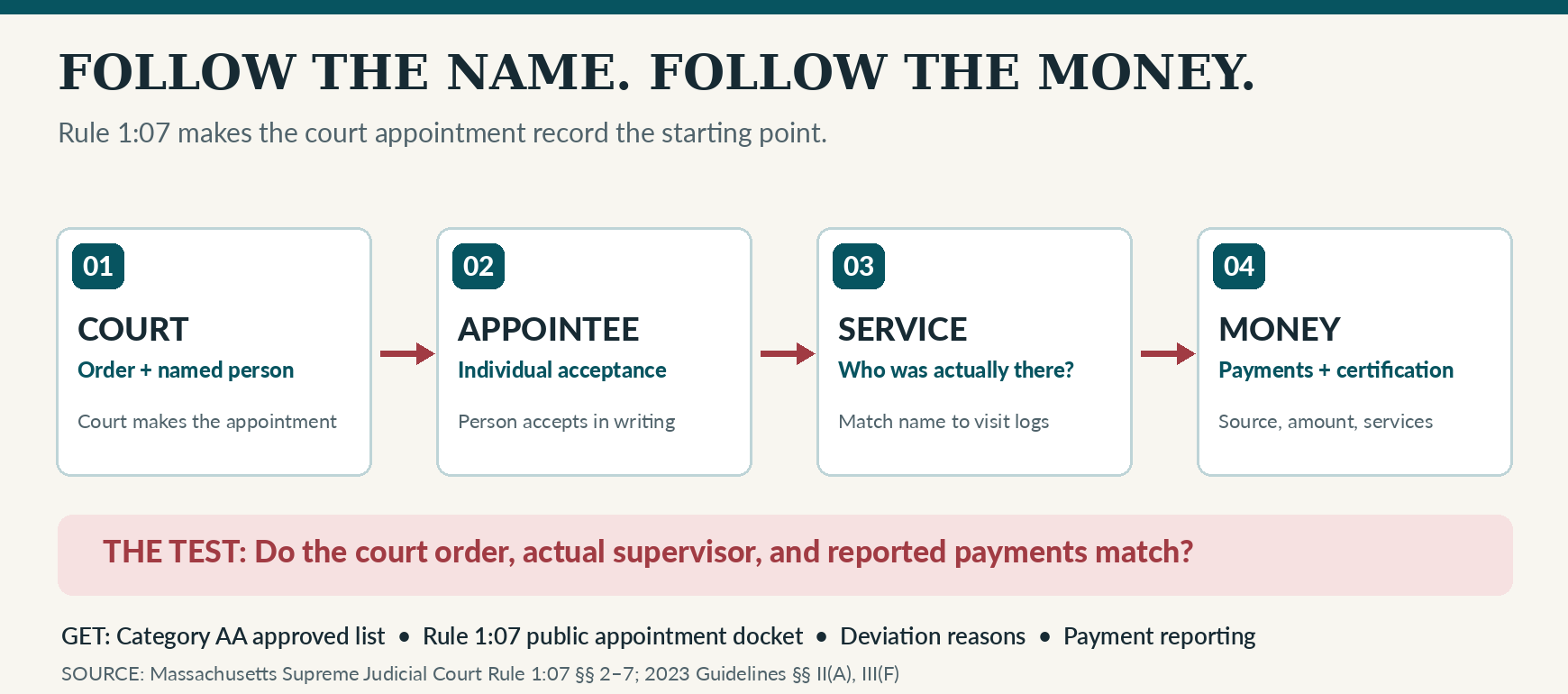
For covered appointments, the test is straightforward: Who was appointed? Who accepted? Who actually conducted the visits?
A private staffing decision cannot replace an individual judicial appointment.
These requirements matter because supervisors have direct responsibility for recognizing danger, interrupting unsafe visits, and documenting a child's distress. Standing Order 1-23, § F.
3. Follow the Appointments. Follow the Money.
Supreme Judicial Court Rule 1:07 was designed to promote fairness and prevent favoritism in fee-generating judicial appointments. It requires public lists of eligible professionals and public appointment dockets identifying who was appointed, by whom, when, and with what reported compensation. Departures from the appointment list or ordinary selection sequence require written explanations. SJC Rule 1:07, Preamble and §§ 2–6.
Section 7 goes further. Before payment on a covered appointment, a sworn statement must document the services provided, compensation, and itemized expenses. SJC Rule 1:07, § 7.

The $25–$30 advertised hourly pay provides a starting point for following the money. Invoices, payment agreements, supervision hours, and employee compensation records can reveal what families were charged, what workers received, and how much revenue the practice retained before expenses.
Massachusetts also restricts billing. Standing Order 1-23(G) limits permissible supervision charges and generally prohibits compelling payment over a parent's objection outside specified statutory exceptions. Standing Order 1-23, § G.
Who receives the appointment? Who performs the work? Who collects the fees?
The answers can reveal whether privately delivered supervision complies with the judiciary's own appointment and financial safeguards.
4. The Records Are Public. What Will They Reveal?
Massachusetts has already established a public-records system capable of illuminating court-generated professional appointments.
Anyone examining the supervision industry can begin at a Probate and Family Court registry by requesting:
The Category AA list of approved professional parenting-time supervisors.
The public Rule 1:07 appointment docket, including names, dates, appointing authorities, appointment categories, and reported payments.
Records of exceptions, identifying appointments made outside the approved list or ordinary selection sequence and the reasons provided.
Related appointment and payment records available for public inspection, with case-specific documents obtained through authorized access.
Read Rule 1:07 | Probate and Family Court Fee-Generating Appointments
Those with authorized access to individual cases can compare appointment orders and written acceptances against supervision logs, invoices, and payment certifications. Court-filed supervision records may be impounded; public appointment dockets and protected case documents have different access requirements. Standing Order 1-23, § E.
Rule 1:07 also provides a formal process, under Uniform Practice I, for requesting removal of a professional from court-generated appointment lists when serious qualification or suitability concerns arise. Rule 1:07, Uniform Practice I.
One courthouse's appointment records can illuminate individual practices. Comparing records across courts could reveal how the larger fee-generating system operates.
The judiciary created the qualifications, the appointment procedures, the prohibition against delegation, and the financial reporting requirements.
Now those records offer a way to examine whether the professionals exercising authority over children actually followed them.
Follow the Appointment. Identify the Supervisor. Trace the Money.
The judiciary wrote the rules. The records are public. Look Closer.
Family Court Watch Collective
Investigations • Survivor Knowledge • Advocacy
Part 2 of The Business Side of Coercive Supervision, published October 27, 2026.