Inside the Massachusetts Family Court System That Turns Child-Safety Concerns Into Court-Appointed Services
Who writes the rules? Who receives the money? And what happens to children who report sexual abuse?
Family Court Watch Collective | Follow the Money
Investigations • Survivor Knowledge • Advocacy
A child reports sexual abuse.
A protective mother asks for the contact to stop.
The family court may appoint a guardian ad litem to investigate. A professional may be ordered to supervise visits. Additional evaluations, interviews, reports, hearings, privilege waivers, and services may follow.
Each appointment can involve another professional. Each service can generate another bill while a child who has been harmed is left suspended in harms way because throughout the process, the child may still be expected to maintain contact with the person accused of abusing them. It is a well known criticism of family courts that they preserve parental rights and access to children over children’s safety.
“What society fears is not that children will be raped again, but that a man might be unjustly deprived of his rights over his children.” -Judge Édouard Durand
(English translation of an excerpt from his French parliamentary testimony on incest and child protection, reproduced by Après la CIASE, April 2026. Read the original French quotation, under “Tout pour le père”)
What kind of child-protection system responds to allegations of sexual abuse by creating more opportunities for paid professionals to facilitate continued access?
Children have been harmed in supervised settings, protective families have paid extraordinary private costs to protect children from sexual abuse on a grand scale, and the public deserves to know how the structure of this system rewards continued contact over actual safety.
The answers may be hiding in Massachusetts' own rules, financial records, and institutional relationships.
1. The language buried in Massachusetts' child-protection guidelines
On June 20, 2023, Massachusetts adopted its Guidelines for Professional Parenting Time Supervisors.
The guidelines say their purpose is to protect children and families.
Yet their introduction contains a remarkable instruction.
In cases involving family violence, sexual abuse, sexual exploitation, or threatened child abduction, courts are directed to assess the child's safety needs, but also:
"the child(ren)'s need for access to the alleged perpetrator"
Think about what that means.
Even when sexual abuse is alleged, the guidelines introduce access to the alleged perpetrator as a need to be considered alongside the child's protection.
Why is the possibility of further abuse competing with an assumed need for contact?
Why is the child's bodily autonomy not the starting point?
And why must a child who has disclosed sexual abuse continue to be evaluated through a framework centered on preserving a relationship with the person accused of harming them and by people who stand to directly profit from the prolonged contact with their named abusers and rapists?
A child is not a parent's property. A biological relationship does not establish an entitlement to access at the expense of safety.
The guidelines contain important protections, but that language raises a fundamental question about the priorities embedded in the policy.
Read the official 2023 introduction
2. When a child reports abuse, another paid appointment may follow
The same guidelines suggest that courts may appoint a Category E guardian ad litem to assist with the safety assessment.
Category E GALs are part of Massachusetts' system of fee-generating professional appointments. Many abuse survivors to report that none of the people on the list are safe or free from inevitable conflicts of interest.
This creates another pathway for a paid professional appointment when a child reports sexual abuse, even before the court determines whether continued contact is safe.
A court may then order professional supervised parenting time, another category of fee-generating appointment.
These are separate decisions, and not every case follows the same path. But the financial structure deserves examination.
Consider the possible sequence:
Child reports abuse → Court appoints a GAL → GAL assesses safety and contact → Court orders professional supervision → Families or other authorized payers fund continuing services.
Where in this sequence is the child's protection independently verified?
Who determines whether another service is actually necessary?
Who measures whether the intervention has reduced harm?
And what happens when the most protective decision would be to stop contact altogether?
If a system generates revenue through court-ordered interventions, the public needs assurance that financial incentives do not influence decisions about whether those interventions continue.
The profession's assurances are not a substitute for independent oversight.
Read Supreme Judicial Court Rule 1:07
3. The domestic violence funding contradiction
Massachusetts funds supervised visitation programs through the Department of Public Health's sexual and domestic violence services system.
The stated mission is to protect survivors and children, provide safe visitation arrangements, and hold people who have used violence accountable.
The DPH program offers important financial protections.
Direct services to survivors are free, voluntary, and confidential. Programs must serve families regardless of ability to pay and provide approved sliding-scale arrangements.
DPH expects the parent who perpetrated violence to pay for services, although a court may determine payment responsibility in court-ordered cases.
These are protections that every survivor should know about.
Yet family courts may order continued contact in disputes involving abuse allegations. A publicly funded visitation center may then be asked to facilitate that contact.
This is the contradiction: Public funding intended to protect survivors can also support services used to carry out court-ordered contact that survivors believe endangers their children and can be forced, coercive and harmful especially to sexual abuse survivors.
Does the program have the independence to refuse an unsafe referral?
Can staff stop visits and insist on a new safety assessment?
What happens when a child makes new abuse disclosures?
Protection funding must produce protection, not merely facilitate access despite when survivors report harm or when children refuse contact.
Read Massachusetts DPH's supervised visitation program policies
4. What protective mothers are not being clearly told
The Massachusetts Law Reform Institute, a prominent legal advocacy organization, maintains public legal information for survivors through Massachusetts Legal Help.
Its supervised visitation guide, reviewed in June 2025, states:
"The state does not pay for parenting time supervisors."
That statement is consistent with the Probate and Family Court's rule that it has no authority to pay for professional parenting time supervisors under Standing Order 1-23.
But the statement alone leaves out critical information.
Massachusetts separately funds supervised visitation programs through DPH.
And MLRI publishes another page identifying state-funded supervised visitation centers across Massachusetts. These are different funding and service arrangements. Explaining that difference is essential.
A protective mother reading the broad statement about state payment could walk away believing there is no publicly funded alternative to hiring a private supervisor.
Why isn't the distinction explained clearly, on the same page, where mothers are looking for help?
Why aren't families directed immediately to the funded-center directory?
Why aren't survivors told that some programs offer free direct services and additional state program oversight?
And why does information that could affect a child's safety and a family's finances require searching across multiple government and legal aid websites?
Access to protection should not depend on knowing the right terminology.
Sources: MLRI's supervised visitation guide and MLRI's state-funded visitation center directory.
5. Who wrote the guidelines?
Massachusetts publicly thanks the members of the Professional Parenting Time Working Group responsible for developing the 2023 guidelines.
The group included court administrators, probation officials, a court clinician, private legal professionals, and representatives of community service organizations.
Among its members was Jamie Sabino, Deputy Director of Advocacy at the Massachusetts Law Reform Institute.
According to MLRI's published biography, Sabino previously spent more than 13 years serving as the Massachusetts Trial Court's Violence Against Women Act STOP Grant Coordinator, working on policy concerning domestic violence and sexual assault.
At MLRI, she leads domestic violence legal advocacy work and facilitates its Family Law Task Force.
That background is significant.
A professional with extensive experience advocating for domestic violence survivors participated in developing the guidelines that direct courts to consider children's access to alleged perpetrators even in cases of sexual abuse.
What happened during the drafting process?
Did anyone challenge that language?
Was a presumption against contact following credible sexual abuse disclosures even considered?
Have children who have been harmed during supervised visitation, or protective mothers who had experienced those failures, consulted?
The published membership list does not identify a dedicated representative of children sexually abused during supervision or a survivor-led organization representing those families and that is noticeably absent.
We want to know whether those voices were present in any other capacity and if the general public would agree with a contact presumption after children’s reports of sexual abuse.
We also want to understand the contributions of each working-group member, without presuming that committee membership means agreement with every provision.
This is not about targeting one advocate.
It is about asking whether the institutions that claim to represent survivors actually brought survivors' most urgent safety concerns into the room where policy was written.
There is another documented professional relationship worth examining.
In an August 26, 2026 memorandum, the Probate and Family Court said it worked with MAGAL and AFCC to develop continuing education for Category E and F guardians ad litem.
That was a separate training initiative, not evidence that those organizations drafted the 2023 supervision guidelines.
But it establishes ongoing collaboration between the court and professional associations in the fee-generating appointment system.
Who shapes the training of court-appointed professionals? Whose research informs their practices? What safeguards prevent conflicts of interest, and where are the voices of children who have disclosed sexual abuse?
Are these professionals being taught Joan Meier’s research documenting the systemic bias against mothers reporting abuse, particularly child sexual abuse, and the devastating custody outcomes associated with parental alienation claims?
Or are they being trained to funnel victims into an endless pipeline of court-ordered evaluations, supervision, and reunification services that can punish protective parents, retraumatize children, generate professional revenue, and facilitate continued access to alleged abusers?
Who is teaching these professionals to recognize abuse, and who is teaching them to manage the victims?
These questions belong in a public examination of professional influence over family court policy.
Sources: Working-group membership, Jamie Sabino's MLRI biography, and August 2026 Category E/F memorandum.
6. Rule 1:07: Follow the appointments. Follow the payments.
Massachusetts already has a rule designed to reduce favoritism and provide transparency in fee-generating court appointments.
Supreme Judicial Court Rule 1:07 requires public appointment dockets containing information such as:
The professional appointed and the type of appointment.
The appointment date and appointing authority.
Whether the appointment departed from the court's required list or sequence.
The amount and source of payments received.
The rule also requires a sworn statement documenting services, payments, and itemized expenses before payment is made or received on covered appointments.
These requirements are not optional public-relations commitments.
They are court rules.
And they create an extraordinary opportunity for independent public oversight. Rule 1:07 records across Massachusetts can determine which professionals repeatedly receive appointments, how much money is documented, how often appointment sequences are bypassed, and whether required payment certifications are maintained.
Examination is needed into how professional associations, training requirements, appointment qualifications, and private service markets intersect.
The public deserves to know who receives court-generated business and to be able to review the safeguards that are in place.
7. What protective parents needs to know now
If your child has disclosed sexual abuse or refuses visitation, know these protections before agreeing to supervised contact.
A child's refusal can require a provider to suspend visits. The Supervised Visitation Network (SVN), Standard 18.3, requires its member providers to have written child-refusal procedures. When refusal raises concerns that continuing visits may harm a child's safety or emotional well-being, the provider must suspend services pending resolution.
SVN Standard 19.2 provides additional safeguards for cases involving child sexual abuse, including specialized training and restrictions on continuing services while allegations are under investigation.
Read SVN Standards 18.3 and 19.2.
Find a center with enforceable safety obligations.
Federal Violence Against Women Act funding supports certain supervised visitation programs through the U.S. Department of Justice's Office on Violence Against Women (OVW). OVW Justice for Families grant recipients providing supervised visitation must follow the federal Safe Havens Guiding Principles, which prioritize the safety of children and adult abuse survivors. Current federal funding rules also prohibit charging either parent for visitation services funded by those grants.
These federal requirements are separate from SVN's child-refusal standard. A center's receipt of VAWA funding alone does not establish that it follows SVN Standard 18.3.
Massachusetts state-funded centers to contact include:
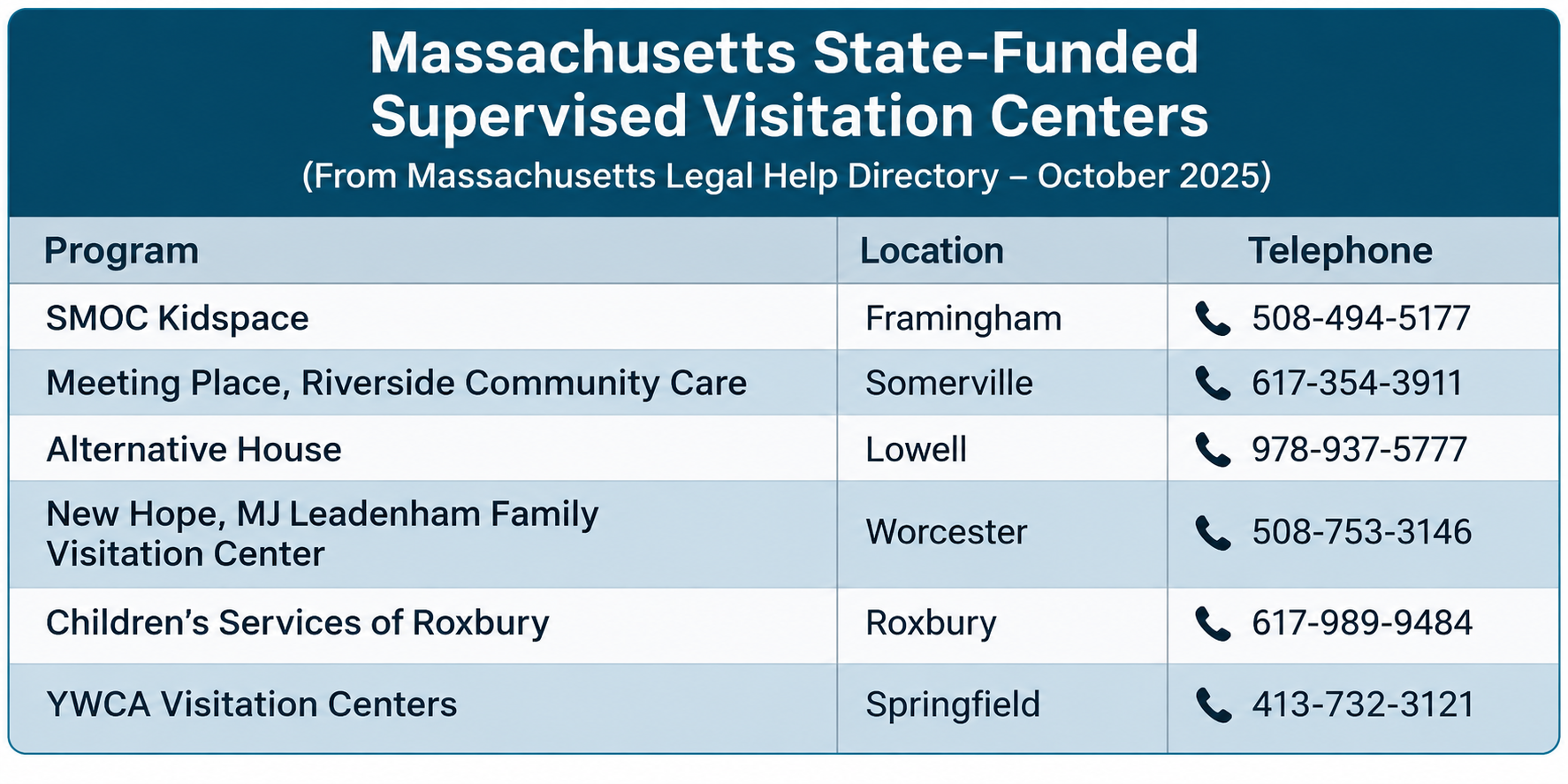
“Table titled ‘Massachusetts State-Funded Supervised Visitation Centers,’ based on the Massachusetts Legal Help directory from October 2025. Six programs are listed with their locations and telephone numbers: SMOC Kidspace, Framingham, 508-494-5177; Meeting Place at Riverside Community Care, Somerville, 617-354-3911; Alternative House, Lowell, 978-937-5777; New Hope MJ Leadenham Family Visitation Center, Worcester, 508-753-3146; Children’s Services of Roxbury, Roxbury, 617-989-9484; and YWCA Visitation Centers, Springfield, 413-732-3121.”
These programs appear in Massachusetts Legal Help's October 2025 directory of state-funded supervised visitation centers. Their current OVW grant status, SVN membership, and child-refusal procedures have not been individually verified.
Find the full Massachusetts state-funded center directory.
Ask these four questions before choosing a center.
Does your program follow SVN Standards 18.3 and 19.2? Will you suspend visits when a child's refusal raises safety or emotional harm concerns?
Do you currently receive OVW Justice for Families funding? If so, what grant-required safety and fee protections apply?
Will my child be continuously observed? What restrictions prevent bathroom access, inappropriate physical contact, secret communication, and other abuse risks?
Will you document and report abuse disclosures, terminate unsafe visits, and notify the court?
Request the center's written policies, not just verbal assurances. Massachusetts court-appointed supervisors also have duties.
Under Massachusetts' 2023 Guidelines for Professional Parenting Time Supervisors, covered supervisors must interrupt, terminate, or reschedule a visit when a child becomes acutely distressed or safety is at risk.
When sexual abuse was considered in ordering supervision, additional restrictions apply, including prohibiting the supervised parent from accompanying the child to the bathroom unless the court orders otherwise.
Read the Massachusetts safety requirements.
A child's refusal or disclosure of sexual abuse must never be dismissed as an inconvenience to completing court-ordered contact. Preserve the child's statements without repeated questioning, document the safety concerns, and seek immediate protective assistance.
8. Follow the Money. Demand Accountability.
Three connected systems need further investigating:
Public funding: Which domestic violence programs receive supervised visitation grants, what safety conditions apply, and whether those conditions are enforced.
Court appointments: Who receives paid appointments, who appoints them, and how much families pay, using Massachusetts Supreme Judicial Court Rule 1:07.
Court policy: Who developed the 2023 supervision guidelines, what evidence informed the safeguards, and why children reporting sexual abuse may still be required to maintain contact.
We want to know why protective families are directed into expensive private services when publicly funded alternatives exist, why safe parents can be placed under supervision without findings of abuse, and who is accountable when children are harmed.
Public money intended to protect abuse survivors must not become another means of perpetuating coercion. Children are more than a revenue stream and safety must come before professional profits.
Love does not require access.
Family Court Watch Collective | Investigations • Survivor Knowledge • Advocacy
Sources, Laws & Safety Resources
Massachusetts Court Rules and Child-Safety Requirements
Massachusetts Guidelines for Professional Parenting Time Supervisors (2023). Official court rules addressing professional supervision, child safety, sexual abuse allegations, and termination of unsafe visits.
Supreme Judicial Court Rule 1:07. Rules governing fee-generating court appointments and public appointment records.
M.G.L. c. 208, § 31A. Massachusetts custody law addressing domestic abuse, children's safety, and parenting time.
Research on Abuse Allegations and Custody Outcomes
Joan S. Meier, Child Custody Outcomes in Cases Involving Parental Alienation and Abuse Allegations. U.S. Department of Justice-funded research examining how abuse allegations and parental alienation claims affect custody outcomes.
Resources for Protective Parents
Supervised Visitation Network Standards. See Standard 18.3 on children's refusal to visit and Standard 19.2 on child sexual abuse.
Massachusetts State-Funded Supervised Visitation Centers. Directory of publicly funded programs, with locations and contact information.
Massachusetts DPH Supervised Visitation Services. Official information about the state's domestic violence-related supervised visitation services and funding framework.
Funding arrangements, eligibility, provider policies, and availability may change. State funding does not establish that a program receives federal VAWA funds or follows every SVN standard.